



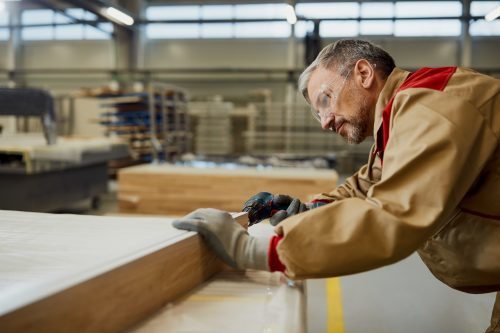
In a woodworking shop, a wood router had been operating for years without a single incident. On an ordinary morning, a worker moved his hand toward the cutting disc, convinced that the machine had been switched off just moments earlier. However, the disc continued to rotate due to inertia. The result was a serious injury that could have been avoided if the machine had been equipped with a functional safety guard and a stopping system that prevented access until all moving parts had come to a complete stop.
Thank you for reading this post, don't forget to subscribe!Scenarios like this are repeated, with variations, in factories, warehouses, and workshops across the country. Mechanical presses, conveyors, palletizers, and routers increase productivity, but by their very nature they remain among the most dangerous work equipment—not because they are improperly designed, but because their safety protections are often neglected, disabled, or simply worn out over time.
Law No. 319/2006 and Government Decision No. 1029/2008 on the conditions for placing machinery on the market, which transposes Directive 2006/42/EC, establish a clear framework: machinery must comply with the essential health and safety requirements from the moment it is placed on the market, accompanied by technical documentation and the EC Declaration of Conformity. However, compliance at the time of purchase is not sufficient. Throughout the entire period of use, the employer remains responsible for maintaining equipment in a safe condition: safety guards must be installed and fully functional, emergency stop devices must be accessible and regularly tested, and workers must be trained regarding the specific risks associated with each machine.
The main risks are essentially the same regardless of the type of machine: contact with moving parts such as wheels, blades, cutters, routers, or conveyors, which can lead to crushing injuries or amputations; the projection of particles or fragments at high speed; clothing or hair becoming caught in moving components; and uncontrolled movements of equipment whose stopping systems no longer function correctly. Many of these risks become apparent only after the original protection has, in one way or another, been bypassed—a guard removed to “work faster,” a safety sensor manually blocked, or maintenance postponed.
This is where the employer’s most important practical obligation comes into play: carrying out a risk assessment for every piece of equipment, not only when it is first put into operation but also periodically, as machinery ages and working conditions change. This should be complemented by a genuine preventive maintenance program—not merely repairs when something breaks down, but scheduled inspections of guards, sensors, and stopping devices—as well as training that goes beyond obtaining a signature on a form and ensures that workers truly understand how the specific machine can cause injury.
Failure to comply with these obligations is not merely an issue of administrative compliance. Depending on the obligation breached, Law No. 319/2006 provides for administrative fines of up to RON 10,000. However, the real consequence of an accident involving inadequately protected machinery is, in most cases, irreversible for the worker involved. An incident such as the one described in the woodworking shop ultimately results in far more than a fine: compensation claims, the temporary suspension of activities, and, above all, an injury from which the worker may never fully recover.