



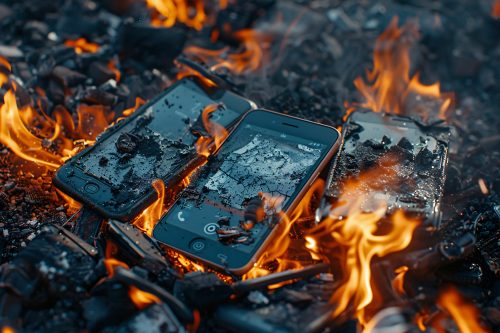
An employee at a courier warehouse notices smoke coming from an electric scooter battery that had been left charging overnight. They appear to react correctly: they take the dry powder fire extinguisher mounted on the wall and extinguish the visible flames. Fifteen minutes later, however, the battery reignites spontaneously, without any external source of ignition—a phenomenon that, to someone familiar with “traditional” fires, seems almost impossible to explain.
Thank you for reading this post, don't forget to subscribe!What actually happened is a phenomenon known in technical literature as thermal runaway: once a lithium-ion cell exceeds a certain internal temperature, it triggers a self-sustaining chemical reaction that generates its own heat and oxygen, regardless of the external environment. A conventional fire extinguisher—whether dry powder, foam, or even carbon dioxide—may extinguish the visible flames on the surface, but it does not stop the reaction continuing inside the damaged cells. This is why reignition, sometimes occurring hours after the initial intervention, is common.
Lithium-ion batteries are no longer found only in mobile phones and laptops. Electric scooters and bicycles, portable power tools, mobile medical equipment, drones, and, increasingly, company electric vehicles have become part of the standard equipment in many workplaces—courier warehouses, workshops, and offices with charging stations for employees’ mobility devices. Each of these batteries represents a source of risk that conventional fire protection equipment, designed for solid materials, flammable liquids, or standard electrical installations, does not explicitly address.
Law No. 307/2006 on fire protection and the General Fire Safety Rules approved by Order of the Ministry of Internal Affairs No. 163/2007 require employers to equip workplaces with fire protection equipment appropriate to the specific risks of the activities carried out—not with a generic set of fire extinguishers selected without considering what may actually catch fire in that particular environment. Where a company stores, charges, or uses significant numbers of lithium-ion battery-powered devices, a dry powder or carbon dioxide extinguisher, although useful for other types of fires, does not adequately address the actual risk present in that workplace.
For this specific type of risk, fire extinguishers based on AVD (Aqueous Vermiculite Dispersion) technology have been developed. This water-based vermiculite dispersion is designed to act on three levels simultaneously: it reduces the spread of heat from one cell to another, isolates the fuel source, and, as the water evaporates, forms a barrier-like layer that limits oxygen access at the battery’s surface. Unlike a conventional extinguisher, which only suppresses the visible flames, this type of extinguishing agent is designed to interrupt the internal thermal reaction, significantly reducing the risk of reignition.
Testing this type of equipment is not carried out under the standard fire extinguisher testing procedures. NTA 8133:2021, a technical standard developed in the Netherlands and the first of its kind internationally, reproduces a real thermal runaway event under laboratory conditions using lithium-ion cells and evaluates whether an extinguishing agent can actively extinguish such a fire within a strict time limit. A fire extinguisher intended for this type of risk must also pass the dielectric test required by the European standard EN 3, which verifies that the extinguishing agent does not conduct electricity—a critical requirement when the battery involved is still energized or partially operational.
The difference between simply having “a fire extinguisher” in the workplace and having the right fire extinguisher for the actual risk becomes clear precisely during a lithium-ion battery incident: correctly selected equipment can stop a reaction that would otherwise continue burning from within long after the visible flames appear to have been extinguished.